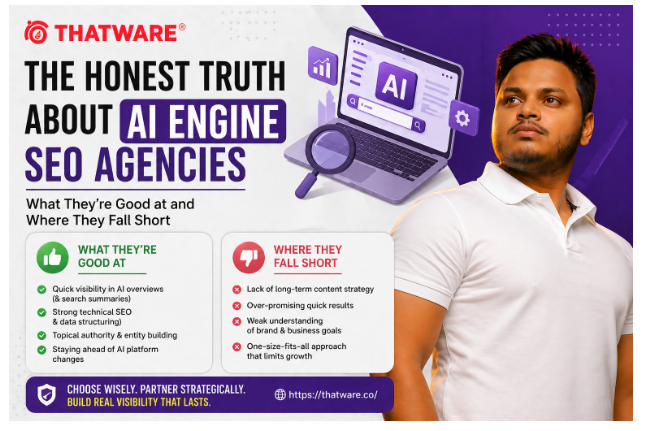
The number of agencies claiming AI engine SEO expertise has multiplied roughly ten times in the last two years. Some are genuine. Some have added “AI” to their existing service list and called it a new offering. And some are somewhere in between – teams that understand the concepts but haven’t built the operational depth to deliver consistently at a high level.
For a brand evaluating AI engine SEO agencies, the challenge isn’t finding one that claims the right capabilities. It’s telling the real from the repositioned.
What Genuine AI Engine SEO Expertise Actually Looks Like
An ai engine seo agency with genuine capability should be able to explain, in concrete terms, how different AI search systems process and rank content. Not at a marketing level – “we optimize for AI” – but at a technical level: how retrieval-augmented generation differs from traditional indexing, what signals AI ranking systems weight differently from traditional PageRank-adjacent systems, how content structure affects extraction likelihood in AI-generated answers.
They should also be able to show case studies that demonstrate AI-specific outcomes – not just “traffic went up” but “our content started appearing in AI Overviews for these specific queries” or “we increased the brand’s entity confidence score as measured by these specific knowledge graph signals.” Those are different measurement frameworks from traditional SEO, and agencies that have genuinely done this work will have them.
What They’re Genuinely Good At
The areas where AI engine SEO agencies tend to deliver real value are the areas that require both technical depth and content strategy sophistication simultaneously. Entity optimization – ensuring that a brand is unambiguously understood by AI systems in terms of what it does, who it serves, and what it’s authoritative about – is a good example. This work involves structured data, knowledge graph optimization, consistent brand description across authoritative third-party sources, and content architecture that communicates expertise signals clearly.
Content extractability work – restructuring content so that AI systems can efficiently pull key claims for AI-generated answers – is another genuine strength. The specific format patterns that produce AI Overview citations are well-understood among teams that have done this work in earnest, and applying those patterns consistently across a content archive is valuable and non-trivial.
Where They Fall Short
AI engine optimization services often oversell the speed of results. AI search optimization, like traditional SEO, is a slow burn. Building the entity authority and content architecture that produces consistent AI Overview citations takes months, not weeks. Agencies that promise rapid visibility improvements in AI-generated search results are either overpromising or measuring outputs that don’t translate to meaningful business outcomes.
The measurement piece is also often underdeveloped. AI Overview citation tracking, entity confidence measurement, and knowledge graph presence monitoring are all areas where the tooling is less mature than traditional rank tracking. Some agencies are honest about this and build custom tracking approaches; others paper over the gap with traditional SEO metrics that don’t actually reflect AI search performance.
The Questions That Separate Real From Repositioned
Before engaging an AI engine SEO agency, ask these things directly. How do you measure AI Overview citation performance? What signals do you prioritize for entity optimization, and how do you track changes in knowledge graph representation? Can you share case studies specifically about AI search visibility, not just general organic traffic? What tools – proprietary or third-party – do you use to measure AI-specific outcomes?
The answers will separate agencies that have genuinely built this capability from those that have updated their marketing language without updating their service delivery.
The Honest Position for Brands Evaluating This Space
Some traditional SEO work is entirely compatible with AI search optimization – genuinely good content, authoritative backlinks, clean technical foundations. A brand that’s done traditional SEO well is already partway there. The incremental work of AI engine optimization adds specific layers – entity clarity, content format optimization, AI-specific structured data – on top of that foundation. The agencies that help most are the ones that can honestly tell you which of those layers you need, not the ones that treat everything as a new problem requiring a new engagement.